[Experiment 11] Building the Supply Chain AI Agent Operating Model Game
Introduction
This is a different experiment from the previous ones. In the previous experiments, it was more about testing something, like if an AI agent could handle a certain task. In this experiment, it is if I can transfer my knowledge and thoughts into a game simulator.
As with some of my previous experiments that included game or simulation building, I didn't build the game myself. I iterated and guided Claude Fable 5.1 and Grok 4.6 within Cursor AI environment.
It should also be said that I did not take any steps to try to make a cheat-proof game. In short, the whole game is in the frontend except the game state, which means that all the game logic and calculations can easily be found in the code. It would have been better to put the game logic in the backend and thereafter obfuscate the frontend code.
I also want to say that this is not some simple simulator that you can play for 5 minutes and thereafter know what is going on. You will need hours of gameplay in order to get a feeling of how trade-offs work with AI agent deployments. I therefore also feel I learned a lot myself from playing the game.
Why build this game?
I have been very vocal about that I believe AI will drastically change how businesses operate. If your business don't act, it can easily fall behind. I also believe that deployment of AI agents is the next step in the AI business transformation.
What seems unclear is the complexity in integrating AI agents in an operating model. In my case, I talk only about the supply chain function, but of course the operating model logic in this game could also be applied to the whole business.
What I mean about integrating AI agents in the operating model is actually just to better understand how the interaction between humans and AI agents should work. Like where to set the boundaries and who have access to agents (to give two examples).
So the purpose of this game is to create awareness and to surface all the trade-offs and questions that must be tackled together with an AI agent implementation.
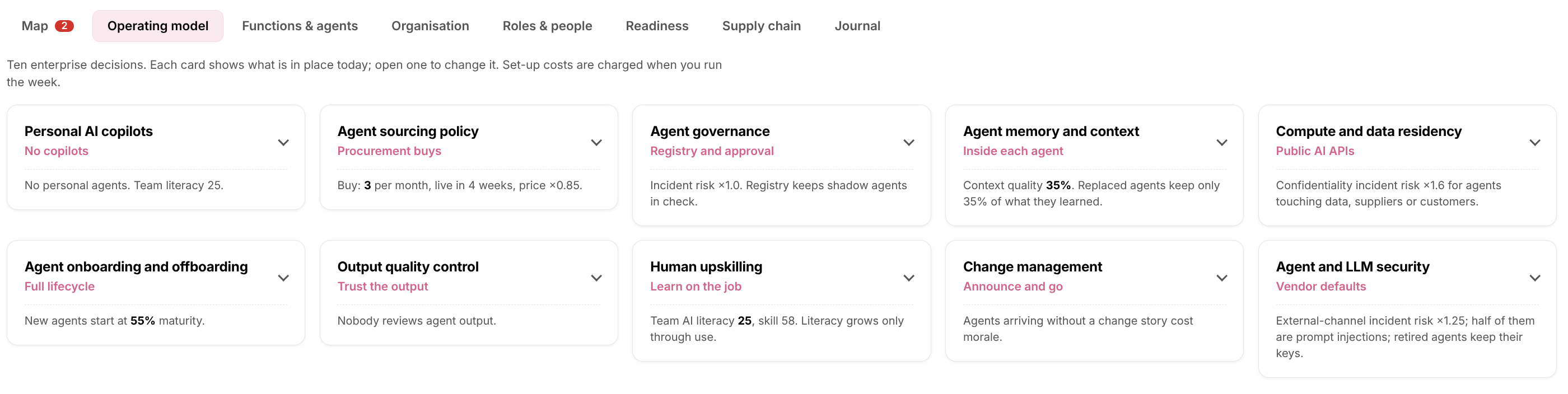
The trade-offs and decisions that I added in the game
Below you can see what I considered the most important trade-offs and decisions to be included in the game.
Trade-offs
- Speed vs safety in terms of governance. It will answer the question how much do we allow the agent to do?
- Agent autonomy vs human oversight. This is more about how much will be verified by a human.
- Processes can be controlled vs dynamic. This is about how much a process should be controlled.
- Slow vs fast process because of data records per step.
- Invest in data quality vs elsewhere. This is about if data quality is the right place to allocate resources.
- Shared memory vs memory inside every agent. This is about setting up a shared company brain that agents can use instead of letting every agent have his own memory.
- AI agents use local AI vs API (confidentiality). This is about if the underlying LLM will be running on the company premises or if it will be an external provider (eg like OpenAI or Anthropic). Locally managed means there is limited confidentiality risks.
- Security investment vs exposure. This is about how much it is worth to invest in security.
- Invest in upskilling vs other resource allocations. This is about how much to invest in people to learn more about AI.
Decisions
- Decide who should have access to agents.
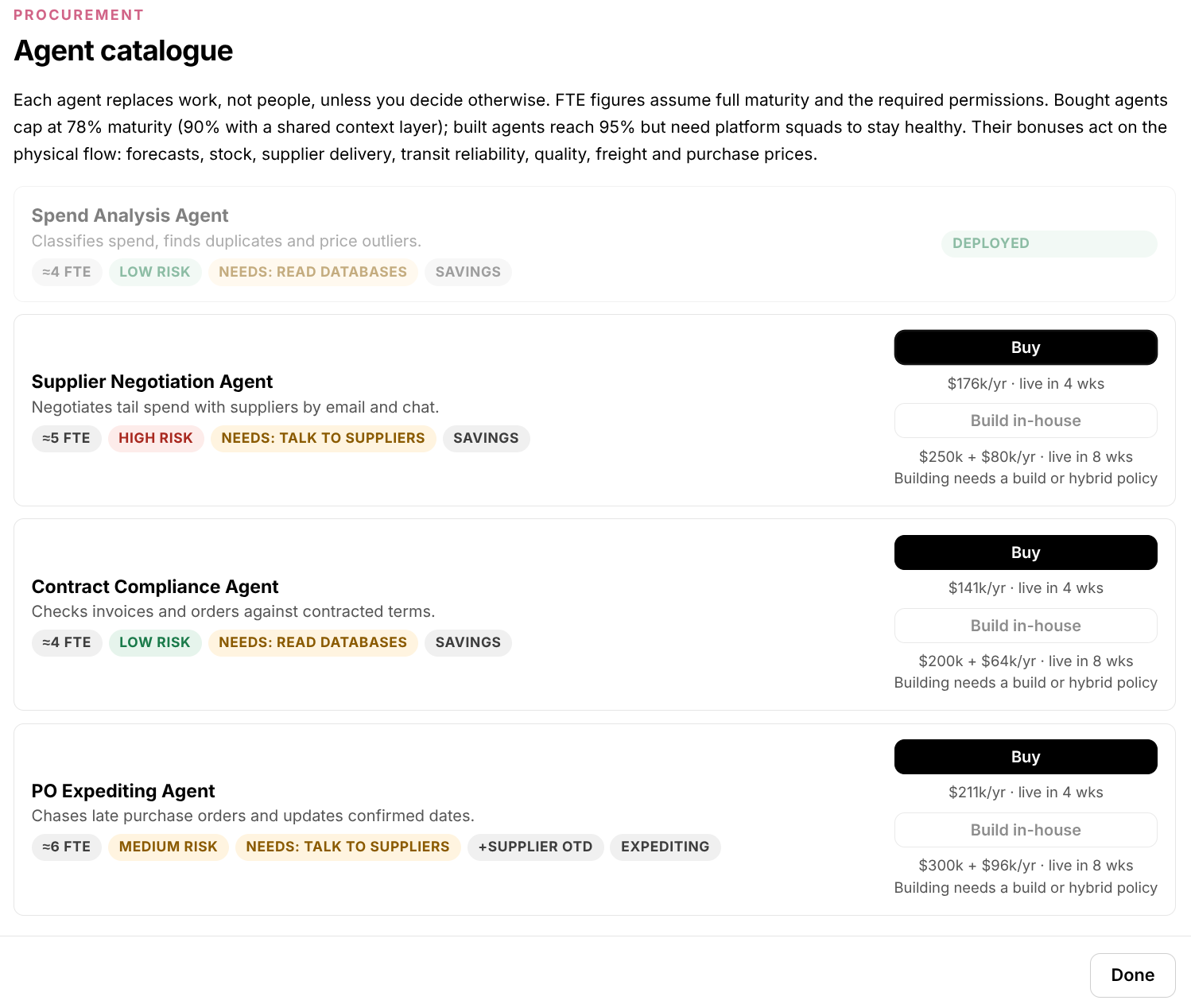
- Decide build internally or buy the agents externally or hybrid.
- Decide how much to govern the agents and what humans need to verify.
- Decide how to do AI literacy upskilling.
- Decide on security level.
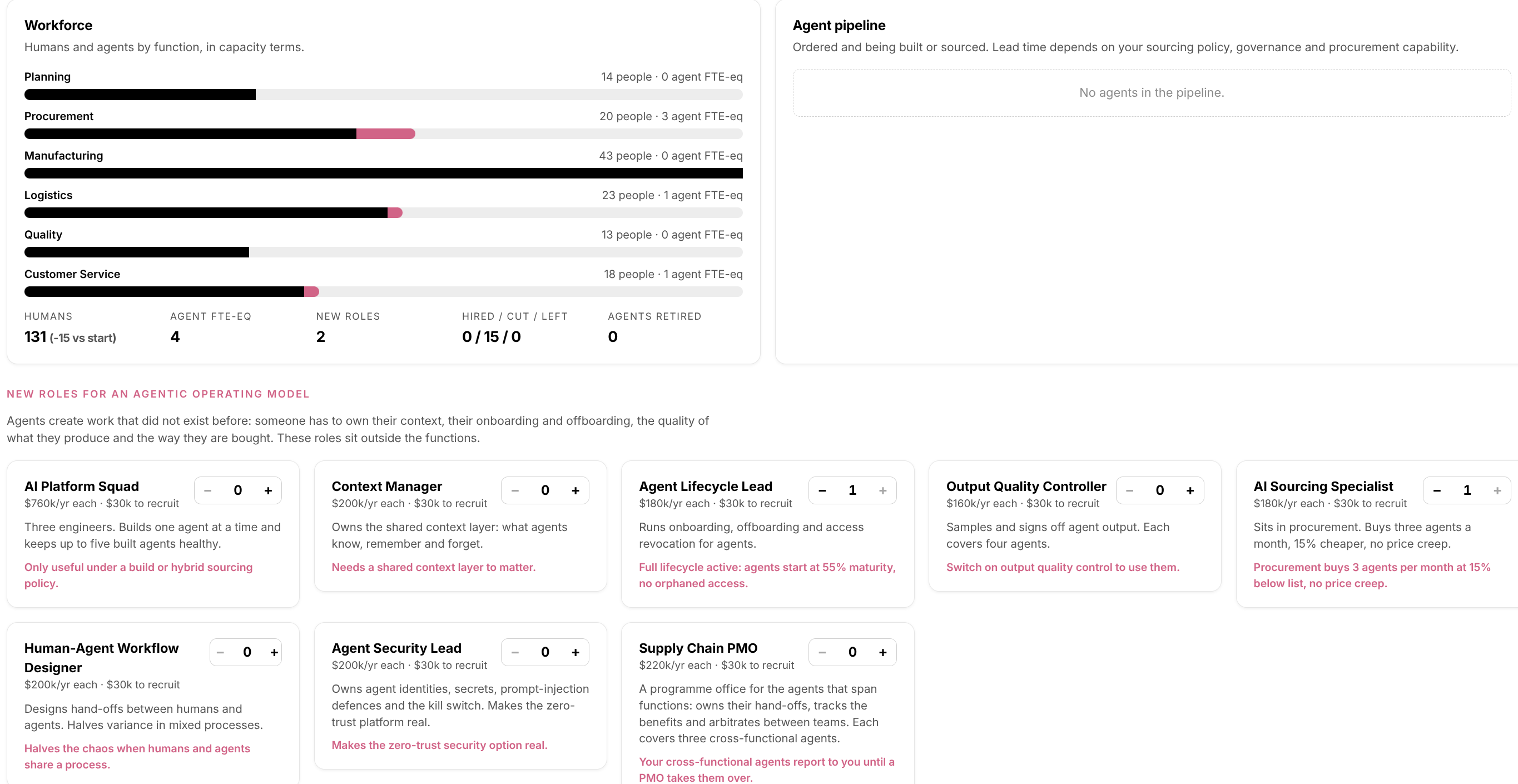
- Decide which on the new roles to hire and how many and when (AI Platform Squad, Context Manager, Agent Lifecycle Lead, Output Quality Controller, AI Sourcing Specialist, Human-Agent Workflow Designer, Agent Security Lead and Supply Chain PMO).
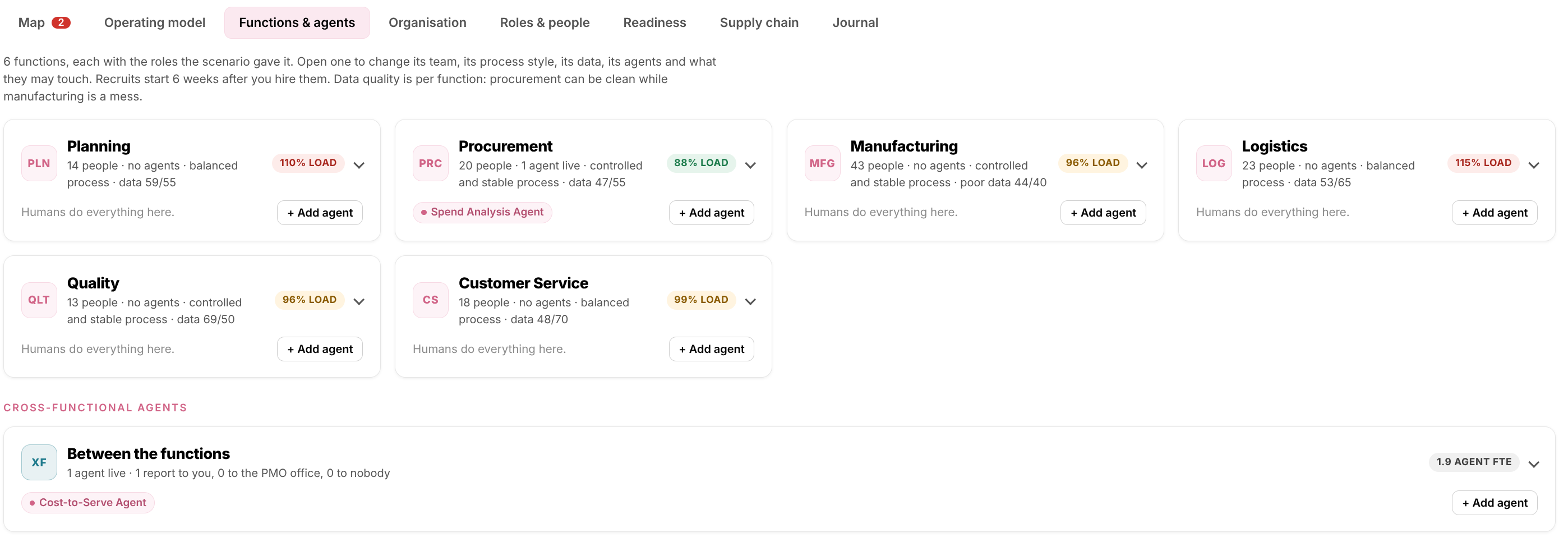
- Decide which agents to deploy in which functions. There are 18 agents in total across the six functions (planning, procurement, manufacturing, logistics, quality, customer service) and there are six cross functional agents available.
- Decide permissions to each agent.
- Decide organisational chart and where agents and humans report.
- Decide if it makes sense to have a central PMO team within the supply chain operating model and what this team will manage.
- Decide if and when to do a readiness diagnostics.
And the outcome
The game tackles well the different tradeoffs and decisions. The complicated thing is that it is just so difficult to measure those impacts. As in a real supply chain business function, lots of things happens at the same time so it is difficult to isolate the impact of certain decisions.
At least, all the requests are well present in the game.
The part where I am less happy is around the scoring of the supply chain operating model. The game kind of values AI agent literacy and integration which means that you as a player can end up at the top of the score board even though you were not profitable.
Improvement suggestions
The following is a list of things I will improve if I launch a second version
- Create a snappier and shorter version. 52 weeks is very long
- A player should be able to simulate some scenarios meaning to set up agents and hire/layoff people etc to see the impact, but without validating. At the moment, any click on those buttons immediately generates the corresponding actions
- Review the scoring and high score mechanism to see if it can be more realistic
Final thoughts
I think the game is really a success. The purpose of the game was to create awareness for the ones playing it, and this is achieved.
I think the question is now around the usage of the game. Who should play it and when? I believe that anyone that goes through an AI agent transformation will benefit from playing it. Probably it is better to play it in an enterprise setting together with colleagues during a special session.
-----------------------------------------------------
Link to the game and screenshots
The game: https://www.aiagentssupplychain.com/OM/
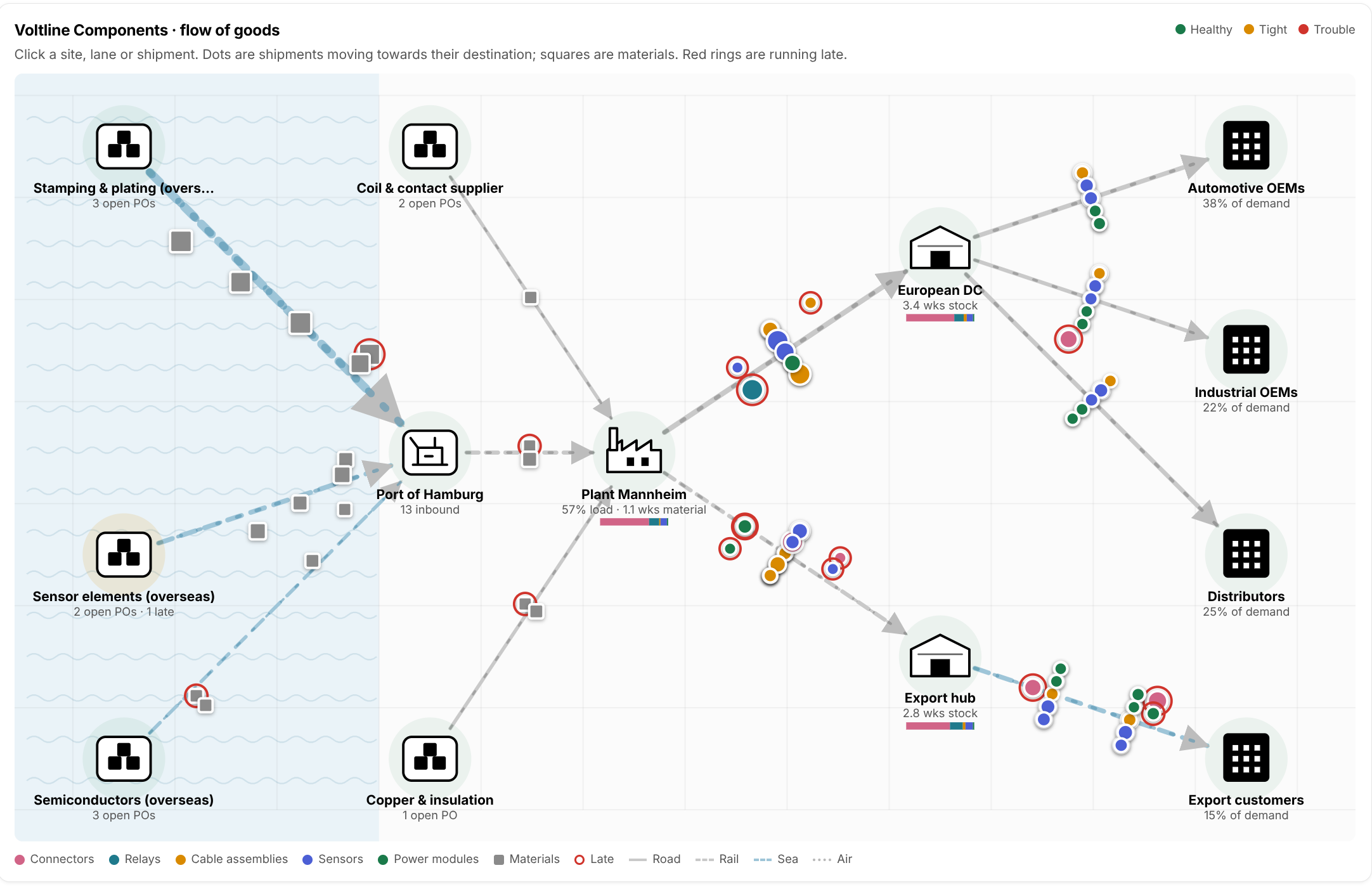
The map:
Operating model decisions:
Functions and agents:
Organisation:
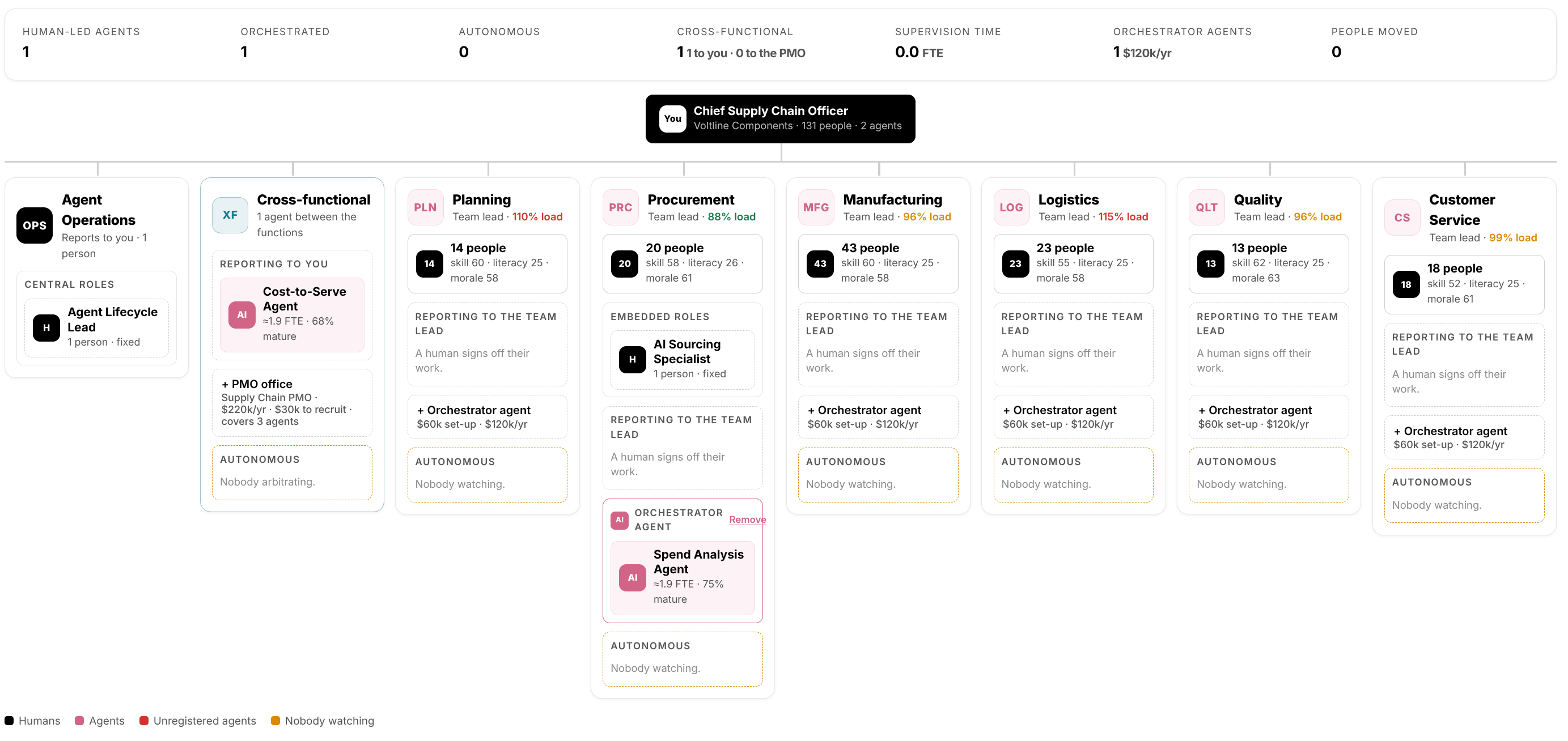
Roles and People
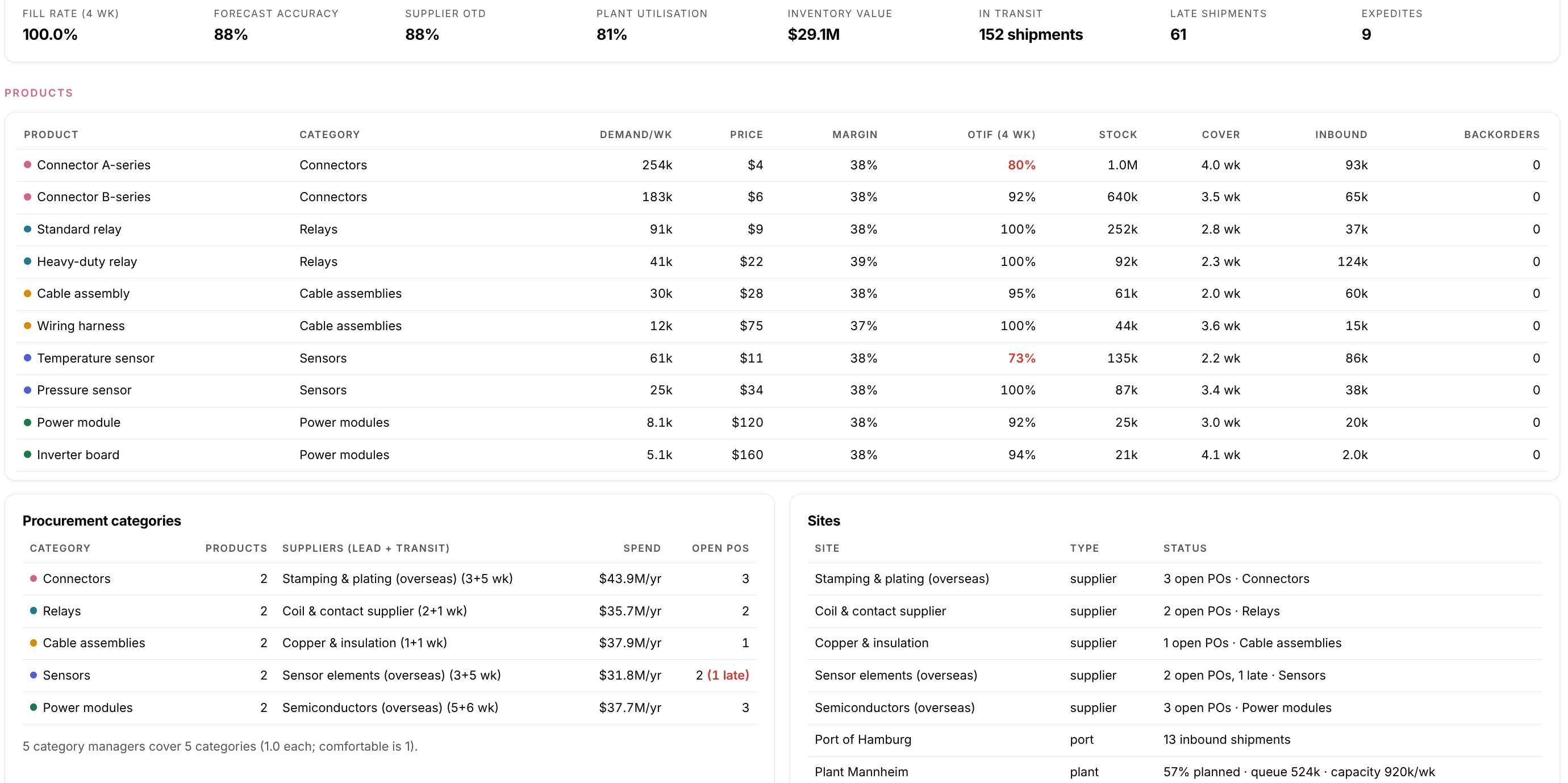
Supply Chain:
Procurement agent selection: